

How To Find Discontinuity Of A Piecewise Function
Quick Overview
- On graphs, the open and airtight circles, or vertical asymptotes fatigued as dashed lines assist us identify discontinuities.
- As earlier, graphs and tables allow us to estimate at all-time.
- When working with formulas, getting cipher in the denominator indicates a bespeak of aperture.
- When working with piecewise-defined functions, cheque for discontinuities at the transition points where 1 slice ends and the next begins.
Examples
Example 1
Using the graph shown below, identify and classify each indicate of discontinuity.
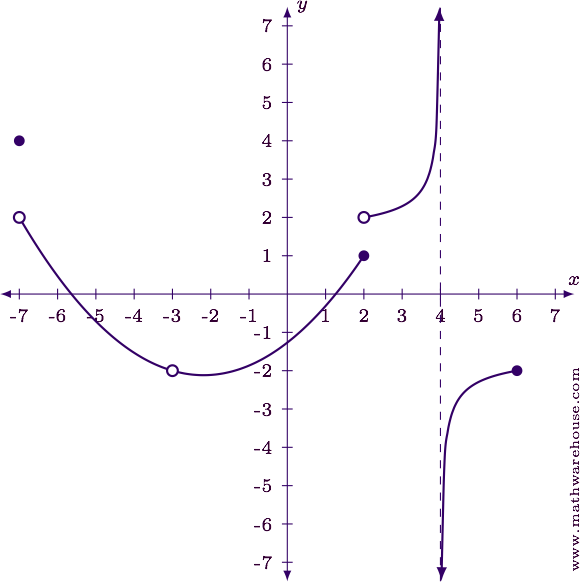 Footstep 1
The table below lists the location ($$x$$-value) of each discontinuity, and the type of discontinuity.
$$ \begin{assortment}{c|l} {ten} & {\mbox{Type}}\\ \hline -7 & \mbox{Mixed}\\ -3 & \mbox{Removable}\\ two & \mbox{Jump}\\ 4 & \mbox{Infinite}\\ 6 & \mbox{Endpoint} \end{array} $$
Note that the discontinuity at $$x=-7$$ is both removable (the part value is different from the 1-sided limit value) and an endpoint (since the graph is non defined to the left of $$x=-7$$).
Example 2
Using the tables below, what type of discontinuity seems to exist at $$x = 5$$?
$$ \begin{assortment}{c|lcc|l} {10} & {f(x)}\\ \hline 4.nine & eight.xv\\ 4.99 & viii.015\\ 4.999 & viii.0015\\ iv.9999 & 8.00015\\ 4.99999 & 8.000015\\ \terminate{assortment} $$
$$ \begin{array}{c|lcc|l} {x} & {f(x)}\\ \hline 5.i & 2.4\\ five.01 & 2.43\\ 5.001 & ii.403\\ 5.0001& 2.4003\\ 5.00001 & 2.40003 \terminate{assortment} $$
Footstep 1
Examine the one-sided limits.
The table on the left tells u.s. $$\lim\limits_{x\to5^-}f(x) \approx 8$$
The table on the right tells us $$\lim\limits_{x\to5^+}f(x) \approx 2.4$$
Answer
The tables pb us to believe the one-sided limits are different, and then we conclude the function likely has a jump discontinuity at $$x = 5$$.
Example 3
Is the part below continuous at its transition indicate? If not, identify the blazon of discontinuity occurring at that place.
$$ f(ten) = \left\{% \begin{array}{ll} x^2, & x\leq 1\\ x+iii, & x > 1 \terminate{assortment} \right. $$
Pace ane
Identify the transition bespeak(s).
The transition point is at $$ten = 1$$ since this is where the function transitions from 1 formula to the next.
Footstep 2
Determine the left-manus limit at the transition point.
$$ \displaystyle\lim_{x\to 1^-} f(x) = \displaystyle\lim_{x\to ane^-} x^ii = 1^2 = 1 $$
Step 3
Determine the right-manus limit at the transition point.
$$ \displaystyle\lim_{x\to 1^+} f(x) = \displaystyle\lim_{x\to one^+} (10+ 3) = 1 + 3 = four $$
Answer
Since the one-sided limits are different, the function has a jump discontinuity at $$x = 1$$.
Example 4
Is the office beneath continuous at ten = 4? If non, place the type of discontinuity occurring at that place.
$$ f(10) = \left\{% \begin{array}{ll} \sqrt 10, & 0\leq x < 4\\ v,& x = 4\\ 6 - x, & x > 4 \end{array} \right. $$
Stride 1
Examine the left-manus limit.
$$ \displaystyle\lim_{10\to iv^-} f(x) = \displaystyle\lim_{x\to four^-} \sqrt x = \sqrt{4} = 2 $$
Step ii
Examine the correct-hand limit.
$$ \displaystyle\lim_{ten\to iv^+} f(x) = \displaystyle\lim_{x\to iv^+} (vi-x) = six -4 = two $$
Step three
Determine the function value.
$$ f(4) = 5 $$
Answer
The limit exists, and the part exists, but they accept dissimilar values. The function has a removable discontinuity at $$ten = iv$$.
Example 5
Without graphing, determine the type of discontinuity the function below has at $$x = three$$.
$$ f(x) = \frac{x^ii + 2x - xv}{x^ii-2x-3} $$
Footstep i
Evaluate $$f(3)$$
$$ f(\blueish 3) = \frac{(\blue{3})^two + 2(\blue{3}) - 15}{(\blue{3})^2-2(\bluish{3})-three} = \frac{9 + 6 - 15}{9-half dozen-3} = \frac 0 0 $$
The function is undefined at $$x = three$$, so there is a discontinuity at this bespeak. To determine the type, we will need to evaluate the limit as $$ten$$ approaches 3.
Footstep two
Since the part has a $$\frac 0 0$$ form at $$x = iii$$, we need to observe and divide out the common factors in the numerator and denominator.
$$ \frac{x^2 + 2x - 15}{x^2-2x-3} = \frac{(x+5)\blue{(x-3)}}{\blue{(x-iii)}(x+1)} = \frac{ten+v}{x+ane} $$
Step 3
Evaluate the limit of the simpler function as $$x$$ approaches three.
$$ \displaystyle\lim_{\blue{x\to3}} \frac{x+v}{x+ane} = \frac{\blueish three + v}{\blue 3 + 1} = \frac viii 4 = 2 $$
Answer
Since the limit exists, but the office value does not, nosotros know the part has is a removable discontinuity at $$x = iii$$.
Example vi
Without graphing, determine the type of aperture the part beneath has at $$x = -1$$.
$$ f(x) = \frac{x^two + 2x - 15}{x^two-2x-iii} $$
Step one
Evaluate $$f(-1)$$
$$ f(\bluish{-i}) = \frac{(\blueish{-1})^ii + 2(\blue{-1}) - 15}{(\blue{-1})^2-two(\bluish{-1})-3} = \frac{1 - two - 15}{1+2-three} = \frac{-16} 0 $$
Since we have partitioning past zero, the part doesn't be at $$x = -1$$. Just, the $$\frac n 0$$ form tells us the function is becoming infinitely large every bit $$10$$ approaches -1.
Note: In social club to determine if the limit is space, we would need to know which direction the function is going every bit $$x$$ approached -1. But for the purposes of classifying the discontinuity, it's plenty to know the function becomes infinitely big.
Answer
The part has an infinite discontinuity at $$x = -1$$.
Keep to Problems

Mistake : Delight Click on "Not a robot", then try downloading again.
Source: https://www.mathwarehouse.com/calculus/continuity/how-to-classify-discontinuities.php
0 Response to "How To Find Discontinuity Of A Piecewise Function"
Post a Comment